
Nicole Oresme und der Frühling der Moderne
The origins of our modern quantitative-metric strategies of world appropriation
and modern culture of consciousness and science by Ulrich Taschow
Oresme Biography
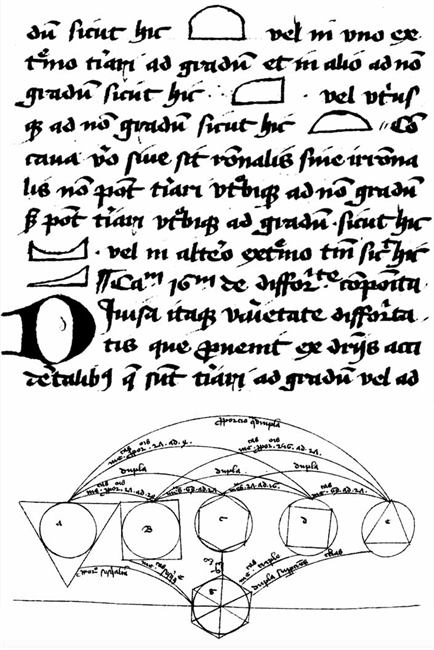
Nicole Oresme: Therefore, I indeed know nothing except that I know that I know nothing.[1] Nicole Oresme was a brilliant philosopher, psychologist, economist, mathematician, physicist, astronomer and musicologist, a passionate theologian, a competent translator, counselor of the King, Bishop of Lisieux, one of the principal founders of modern sciences,[2] probably the most original thinker of the 14th century and - so to speak - the "French Einstein of the 14th century". And last, but not least, like no other of his time Oresme was able to popularize the sciences.Oresme's lifeOresme was born in 1323 (c. 1320-1325) in the village of Allemagne (today's Fleury-sur-Orne) in the vicinity of Caen, Normandy, in the Diocese of Bayeux. Practically nothing is known concerning his family. The fact that Oresme attended the royally sponsored and subsidized College of Navarre, an institution for students too poor to pay their expenses while studying at the University of Paris, makes it probable that he came from a peasant family.Oresme studied the “artes” in Paris (before 1342), together with Jean Buridan (the so-called founder of the French school of natural philosophy), Albert of Saxony and perhaps Marsilius of Inghen, and there received the Magister Artium. A recently discovered papal letter of provision granting Oresme an expectation of a benefice establishes that he was already a regent master in arts by 1342. This early dating of Oresme's arts degree places him at Paris during the crisis over William of Ockham's natural philosophy. In 1348, he was a student of theology in Paris, in 1356, he received his doctorate and in the same year he became grand master (grand-maître) of the Collège de Navarre. Many of his most thoughtful Latin treatises antedate 1360 (see the chronology of his works), and show that Oresme was already an established schoolman of teh highest reputation, which attracted the attention of the royal family, and brought him into intimate contact with the future Charles V in 1356. Beginning in 1356, during the captivity of his father, John II, in England, Charles acted as regent and from 1364 until 1380, King of France. On November 2, 1359, Oresme became "secretaire du roi" and in the period following, it appears that he became chaplain and counsellor to the king. There is a long tradition that says that Nicole Oresme was also the tutor to the dauphin (who later became Charles V), but this is not quite certain. Charles appears to have had the highest esteem for Oresme’s character and talents, often followed his counsel, and made him write many works in French for the purpose of popularizing the sciences and of developing a taste for learning in the kingdom. At Charles’ insistence Oresme delivered a discourse before the papal court at Avignon, denouncing the ecclesiastical disorder of the time. Much can be said about the fact that Oreseme was a lifelong intimate friend and consultant of King Charles, "Le Sage", until his death in 1380. His influence on Charles’ progressive political, economical, ethical and philosophical thinking was probably quite strong, but an extensive investigation of these facts has not been tackled yet. Oresme was the most important person of a choice circle of intellectuals like Raoul de Presle, Philippe de Mézières, etc. at Charles’ court. Royal reliance on Oresme’s capabilities is evidenced, when the grand master of Navarre, was sent by the dauphin to seek a loan from the municipal authorities of Rouen in 1356 (see above) and then in 1360. In 1361, with the support of Charles, while still grand master of Navarre, Oresme was appointed archdeacon of Bayeux. It is knwon that the fervent schoolman Oresme unwillingly surrendered the interesting post of grand master. Oresme's scientific workOresme is best known as an economist, mathematician, and a physicist, according Taschow's book "Nicole Oresme und der Frühling der Moderne" also as a musicologist, psychologist and philosopher. Oresme's economic views are contained in "Commentary on the Ethics of Aristotle", of which the French version is dated 1370; "Commentary on the Politics and the Economics of Aristotle", French edition, 1371; and Treatise on Coins (De origine, natura, jure et mutationibus monetarum). These three works were written in both Latin and French; and all of them, especially the last, stamp their author as the precursor of the science of political economy, and reveal his mastery of the French language. In this way, Oresme became a "sooner founder" of the French scientific language and terminology. He created a large number of French scientific terms and anticipated the usage of Latin words in the scientific language of the 18th century. The French "Commentary on the Ethics of Aristotle" was printed in Paris in 1488; that on the Politics and the Economics, in 1489. The Treatise on coins, De origine, natura, jure et mutationibus monetarum was printed in Paris early in the sixteenth century, also at Lyons in 1675, as an appendix to the De re monetaria of Marquardus Freherus, is included in the Sacra bibliotheca sanctorum Patrum of Margaronus de la Bigne IX, (Paris, 1859), p. 159, and in the Acta publica monetaria of David Thomas de Hagelstein (Augsburg, 1642). The Traictié de la première invention des monnoies in French was printed at Bruges in 1477.If we are to make some of the following excursions into the fields of Oresme’s universal work such as in mathematics, musicology, psychology, natural philosophy, and physics, we need only illuminate a small part of each of them: Mathematics: His most important contributions to mathematics are contained in Tractatus de configuratione qualitatum et motuum, still in manuscript. An abridgment of this work printed as Tractatus de latitudinibus formarum of Johannes de Sancto Martino (1482, 1486, 1505 and 1515), for a long time has been the only source for the study of Oresme's mathematical ideas. In a quality, or accidental form, such as heat, the Scholastics distinguished the intensio (the degree of heat at each point) and the extensio (as the length of the heated rod). These two terms were often replaced by latitudo and longitudo, and from the time of St. Thomas until far into the fourteenth century, there was lively debate on the latitudo formae. For the sake of clarity, Oresme conceived the idea of employing what we should now call rectangular co-ordinates, in modern terminology, a length proportionate to the longitudo was the abscissa at a given point, and a perpendicular at that point, proportional to the latitudo, was the ordinate. Oresme shows that a geometrical property of such a figure could be regarded as corresponding to a property of the form itself. The parameters longitudo and latitudo can vary or remain constant. Oresme defines latitudo uniformis as that which is represented by a line parallel to the longitude, and any other latitudo is difformis; the latitudo uniformiter difformis is represented by a right line inclined to the axis of the longitude. Oresme proved that this definition is equivalent to an algebraic relation in which the longitudes and latitudes of any three points would figure: i.e., he gives the equation of the right line, and thus long precedes Descartes in the invention of analytical geometry. In this doctrine, Oresme extends to figures of three dimensions. Besides the longitude and latitude of a form, he considerd the mensura, or quantitas, of the form, proportional to the area of the figure representing it. He proved this theorem: A form uniformiter difformis has the same quantitiy as a form uniformis of the same longitude and having as latitude the mean between the two extreme limits of the first. He then showed that his method of figuring the latitude of forms is applicable to the movement of a point, on condition that the time is taken as longitude and the speed as latitude; quantity is, then, the space covered in a given time. In virtue of this transposition, the theorem of the latitude uniformiter difformis became the law of the space traversed in case of uniformly varied motion. Oresme's demonstration is exactly the same as that which made Galileo a celebrated person in the seventeenth century. Moreover, this law was never forgotten during the interval between Oresme and Galileo because it was taught at Oxford by William Heytesbury and his followers, then at Paris and in Italy, by all the subsequent followers of this school. In the middle of the sixteenth century, long before Galileo, the Dominican Dominic Soto applied the law to the uniformly accelerated falling of heavy bodies and to the uniformly decreasing ascension of projectiles. In Algorismus proportionum and De proportionibus proportionum, Oresme developed the first calculation-method of powers with fractional irrational exponents, i.e. the calculation with irrational proportions (proportio proportionum). The basis of this method was Oresme’s equalization of continuous magnitudes and discrete numbers, an idea that Oresme took out of the musical monochord-theory (sectio canonis). In this way, Oresme overcame the Pythagorean prohibition of regular division of Pythagorean intervals like 8/9, 1/2, 3/4, 2/3 and provided the tool to generate the equal temperament 250 years before Simon Stevin. Here an example for the equal division of octave in 12 parts:  For instance, Oresme used this method in his musical section of the Tractatus de configurationibus qualitatum et motuum in context of his overtone or partial tone theory (see below)to produce irrational proportions of sound (ugly timbre or tone colour) in the direction of a “partial tone continuum” (white noise).[4] For instance, Oresme used this method in his musical section of the Tractatus de configurationibus qualitatum et motuum in context of his overtone or partial tone theory (see below)to produce irrational proportions of sound (ugly timbre or tone colour) in the direction of a “partial tone continuum” (white noise).[4]Finally Oresme was very interested in limits, threshold values and infinite series by means of geometric additions (Tractatus de configurationibus qualitatum et motuum, Questiones super geometriam Euclidis) that prepared the way for the infinitesimal calculus of Descartes and Galileo. For Oresme’s anticipation of modern |